
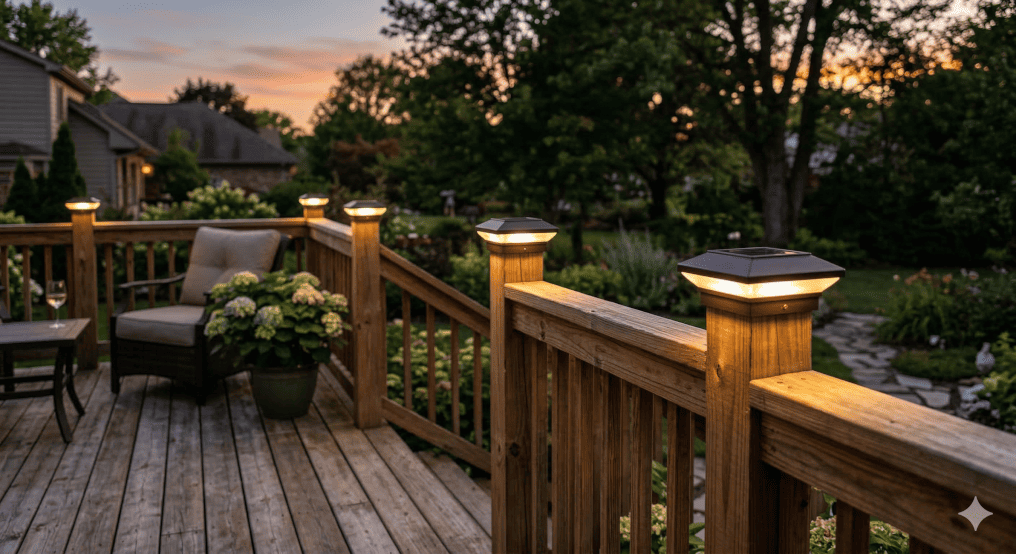
Eight years back I did a deck project for my close friend. We had just finished staining a beautiful cedar wrap-around porch and he was going for that “resort vibe.” He wanted to install recessed and post-top lighting. We had seen some wired kits and thought it would be a viable option until my friend noticed the price. We would have to drill through those fresh, expensive beams and run 50 ft of low-voltage cable. Not to mention the cost of a transformer. We decided to try some solar lighting instead. They just lasted three months before they turned into low quality foggy paperweights from the rain.
An illuminating experience drives my passion for the last ten years to find the perfect combination of solar post caps that are affordable, cost-saving, and functional. I can finally say that with the evolution of solar technology, I have developed solar caps that outperform most traditional wired bulbs. When choosing solar caps for your home, it is important to know that you are not just putting solar caps on your deck railing. You are turning your outdoor living space into an area of utility free coziness. With the right system you can turn a dark and dreary stairway into something truly magnificent and you can do it all for free with out exercise.
There is no need to be afraid of dark stairways, because with post cap lighting comes the warm inviting glow of the sun to keep your space lit and utility bill free.
Quality post cap lighting offers four huge benefits.
- SAFETY: Post cap lighting illuminates and defines stairways so that trips and falls are no longer a concern.
- No More Utility Bills: Your lighting will be paid for by the sun for the next ten years.
- Blackout Immunity: While the grid is down during a storm, your deck remains lit and secure. \n\n• Quick And Easy DIY Installation: No trenching, No wiring, and No paying an electrician $150 an hour.
What Are Deck Post Solar Light Caps and How Do They Actually Work?
Have you ever wondered how a little solar panel is able to power a light for 12 hours? It’s the three components: solar panel, battery, and LED. A deck post solar light caps is a mini power generator on your deck. The solar panel is a mini power plant that makes energy. The battery solar light caps uses is a LiFePO4 cell and is the highest performing battery in 2026.\n\nAs the light level gets darker, the battery that the sensors detect in the light are triggered and turn on the LED to produce, light. The lovely invention of 2026 is the energy consumption. It is a huge upgrade to the old, bluish LED to the new, warm, white chips that mimic the feel of incandescents but use 90* less power.
As someone with years of experience installing systems, I’ve learned to appreciate the systems that you don’t have to think about. These systems capture energy even when it’s gray out so you can still have some light even in November when it’s cloudy for the entire week. It’s not magic, it’s just really good engineering. The “brain” or “controller” in the light caps makes sure to not overcharge the battery or drain the battery too fast at night.
What are the benefits of Deck post solar light caps being used around the home?
What I usually tell clients when they ask about going solar is what I call the “three-year rule.” Here’s why I go to bat for these systems.
– You can literally put a solar cap anywhere. If you want a light on a railing post that’s 100 feet from the house, it can be done. No wires, no limits.
Weather Resistance: Premium solar units now come with “IP65” or “IP67” ratings which means they can withstand a pressure washer or a blizzard and still function. I once had a client with all plastic models that we replaced every winter after a rainy season and instead of educating him, I now do installs of models that will survive all weather.
Financial Independence: Traditional outdoor lighting is a slow and secretive financial leak. The cost of the conduit and the monthly electricity draw is a cumulative cost. Premium solar units save you money in installation costs.
Little Upkeep Required: Modern LEDs are rated at over 50000 hours, which is more than 13 years if you run them 10 hours a night, and that means they are set and forget.
Key Features to Consider for 2026
When checking out our latest solar light deck caps collection, don’t just check out the look. You need to look at the details. Here’s what matters in 2026:
Light Output & Brightness
If you want actual visibility in the dark, I never recommend anything below 50 lumens for deck caps. For high-traffic walkways or security-oriented areas, these high lumen models are game changers. Plus, you can order the lights with a “Warm White” (2700K to 3000K) light to help keep that warm and cozy feel in the backyard.
Battery Capacity & Type
The “gold standard” at the moment is the LiFePO4 battery. These are way better than the old Ni-MH batteries found in cheap hardware store lights. They are better at handling heat, charge faster, are able to be recharged more than 2,000 times, and thus have a lifespan of 5-7 years before you need to even think about a battery swap.
Materials: Aluminum vs Plastic
In my experience, plastic might be okay for a temporary solution, but if you want your deck to look good, you should go for die cast aluminum or stainless steel because they dissipate heat better, thus preventing the LED chips from burning out too soon.
Smart Features & Sensors
A lot of our models for 2026 are featuring “Dual-Mode” sensors for the first time ever. These sensors stay dimmed from 0% to 20% brightness to help save battery and create ambient lighting. However, once users walk by, they’ll jump to 100% brightness to help boost safety and security. These sensors are big-faced game changers for battery conservation and safety for shorter days during the winter.
Different Types/Styles of Deck Post Solar Light Caps and Which to Choose
Looking for the right style is about choosing the right match for your decor. Here’s what seems to work the best based on our observations.
1. Standard_pyramid_caps These beauties are mounted on the top of 4 by 4 or 6 by 6 posts. They are the “crop of the crop” of deck lighting. Best for the full “envelope” of your deck.
2. Flat-Top Moden Caps These are sleek, with some having an entire surface lighting surface, and are profile mounted. Best for an ultra modern minimalist approach to deck design.
3. Glass-Top Mission Styles These are for the craftsman styles, with real tempered glass and of more significant weight. For the money, plastic looks low end.
4. Universal Fit Caps These are the ones for which multiple bases are included. I won’t lie, I think, in older decks, the Fit Universal are the only ones which are not meant to be 3.5” or 5.5” sizes.
For most people, a combination of styles works best. I recommend using standard pyramid caps for the corners, and side-mount deck lights for stairs. This way, you create a multi-dimensional, professional appearance.
You can also read our article on decking solar lighting. In it, we discuss all types of such lighting and the specifics of their use in detail.
Best Deck Post Solar Light Caps
They have endured the Colorado blizzards and endured the extreme heat of Florida. These best sellers are:
• The Titan 4×4 Pro (/product/titan-4×4-pro)
– 150 lumens and 5 years of battery life. Aluminum housing. Best for decks that require serious and reliable lighting.
• The Heritage Glass Cap (/product/heritage-glass-cap)
– Best for classic wooden decks, with a warm 3000K glow and a real glass pane.
• Slimline Deck Marker (/product/slimline-post-marker)
– 60 lumens. Best for a side-mount. Waterproof IP67.
• The Glow-Rail Side Mount (/product/glow-rail-side-mount)
– Downward beam and 12 hour runs. Best for highlighting the wood grain.
• Modern Slate Post Cap (/product/modern-slate-solar-cap)
– 100 lumens, monocrystalline panel. Best for composite decks.
• The Guardian Motion-Sensor Cap (/product/guardian-motion-cap)
– Best for decking that dims to 20 lumens. Kicks to 200 when motion is detected.• Best for: Battery-saving and securing lighting options on cloudy days.
- Copper-Finish Estate Light (/product/copper-estate-solar)
- Genuine copper plating that will patina with age.
- Custom finishes with period accuracy for period-style homes.
- The All-Season Post Lantern (/product/all-season-post-lantern)
- Specs: Oversized solar panel for optimized performance in winter.
- Best for: Decks with overhanging trees or less direct sun.
Step-by-Step Installation Guide + Common Mistakes
Installing a deck post solar light caps system is a Saturday afternoon project, not a week. Here is my 10-minute tutorial on how to get things right.
The Steps:
1. The Sunlight Audit: Before you drill a single hole, place your lights on the deck and let them sit for a full day. Note the shadows. A post that’s sunny at 10 am might be in full shade by 2 pm.
2. Surface Prep: Clean your post tops. For wooden ones, make sure the surface is dry and free of debris.
3. Pilot Holes: If you will be screwing into hardwood like Ipe or pressure-treated pine, it is a must to drill a pilot hole first. This is to avoid the wood splitting and for the light to be level.4. The “First Charge” Rule: Most people will turn these on right away. Don’t do this. Leave the switch in the “OFF” position for 24 to 48 hours in direct sunlight. This “primes” the battery for a longer lifespan.
Mistakes to Avoid:
• Shadow Snagging: Placing a light under a deep railing where the panel only receives 2 hours of sun. If the panel is shaded, the battery won’t charge, and the light will die by 9 PM.
• Light Competition: Don’t place your deck post solar light caps right beside a bright porch light. The sensor may think it’s still daytime and not turn on at all!
• Over Tightening: When putting on the cap to the post, don’t tighten it too much. You might crack the plastic housing or strip the wood.
How to Make Your Deck Post Solar Light Caps Last 7–10+ Years
I hate seeing good hardware go to the landfill. If you put a little care into your outdoor solar lights, you will see them last for a decade.
Here are some things to consider when caring for your solar lights:
• Six Month Wipe Down: Every 6 months, snow, dust, pollen, and bird poop will cover the solar panels and block a good portion of the sun’s rays. Just like a dimmer switch, the faster you wipe them down, the more efficient they will work. ~Spring and Fall~, use a damp cloth and wipe the panels to increase the efficiency of solar charging.
• Winter Care: If you live in an area that gets high snow and drift (5ft snow drifts), then you’ll want to keep the snow off of the solar panels, as they work better when it’s super cold out, but they are still unable to absorb the rays if there are like 3 inches of snow cover.
• Battery Refresh: Do you still notice your lights lasting 3-4 hours? Before tossing the units, it’s important to note that after 3-4 years the LiFePO4 battery that is housed inside can be swapped out in less than 2 minutes (usually). It typically mobile battery packs lite this for 10 minutes as they are usually less than $15.
• Seals: Every year, make sure to adjust the mounting screws by a quarter to ensure the wood is still expanding, contracting, and holds everything securely in place.
Solar Decking vs. Traditional Wired Lights: Quick Comparison
| Feature | Deck Post Solar Light Caps | Traditional Wired Lighting |
| Install Difficulty | Easy (DIY) | Hard (Requires Pro) |
| Ongoing Cost | $0 | Monthly Electric Bill |
| Power Outage | Works perfectly | Goes dark |
| Safety | No wires / Low Heat | Trip hazards / High Heat |
| Flexibility | Move them anytime | Permanent once buried |
| Environment | 100% Renewable | Grid-dependent |
Why Choose Deck Post Solar Light Caps in 2026?
As we approach 2026 the new decks post solar light caps systems are the best option. We don’t have to compromise on anything. We’ll have the brightness, toughness, and the looks to compete with any wired system. I’ve seen how a dark and kind of frightening backyard can be completely transformed into a warm and inviting space in only a few hours.
Here at ralighting, we believe in long-lasting, eco-friendly, illumination solutions for pathways that endure rain, shine, and the test of time (in other words, years). Our high-lumen, LiFePO4-powered solutions are a smart investment for both your home and your wallet, as they transform a hazardous walkway into a safe one and a patio into a retreat.
Don’t let the outdoors of your home stay dark! Check out our collection to see the specifications and, if you have any questions, remember that we have tried out every single model that we offer. Stop wasting your hard-earned cash on your electric bill and start saving it by using your patio during the day. Come check out our full collection of solar light caps for your deck posts and light the way to a better, sustainable, outdoor space!
Common Questions
Q: Do these lights work in the winter?
A: Absolutely! Modern solar deck caps are built for cold temperatures. They may still provide safety lighting for 8 hours instead of 12 due to shorter days; but regardless, they will provide safety lighting all night long! Just keep the panels snow-free.
Q: How long do the LEDs actually last?
A: Most of our deck post solar light caps units use LEDs rated for 50,000 hours, which is over 13 years for 10 hours of use per day!
Q: Can I install these on a composite deck (like Trex)?
A: Yes, solar is even better for composite decks because the traditional bulbs won’t warp the material with their heat, and you won’t have to drill to run wires through the hollow posts.
Q: What happens if it hails?
A: Our premium models use tempered glass or high-impact polycarbonate and are built for 1 inch hail at terminal velocity. I’ve seen them survive storms that dented cars!
Q: What are the light requirements for my deck?
A: If the deck lighting is strictly for ambiance, then 50-80 lumens is sufficient. If you want to light stairs or busy areas, you want at least 150 lumens.
Q: Can I change the batteries?
A: On our better models, yes! We believe in sustainability, so instead of replacing the whole light fixture 5-7 years, we make it easy to change the battery.
Q: will my light color be compatible with the other outdoor lights I have?
A: We have most lights in a “warm white” which is about 3000K, so it looks like an incandescent bulb. We have “cool white” if you want a newer, bluer look.