
In recent years, the cost of living has taken a sharp turn. Across Europe and the United States, utility bills have skyrocketed, leaving millions of families struggling to keep the lights on. This trend has placed significant financial strain on households, with some families struggling to keep the lights on. For instance, in a BBC report from early 2026, Kristy Hallowell from New York shared how her energy bill tripled to $1,800 a month after losing her job, leaving her without electricity for six months and accumulating around $3,000 in utility debt.
Similar stories are increasingly common: analyses show that past-due utility balances climbed 32% since 2022 (from $597 to $789 on average), and utility debt rose 31% between late 2023 and mid-2025. Reports indicate that up to 4 million households faced disconnections in 2025, an increase from previous years, while residential electricity prices rose over 6% in 2025—more than double the rate of inflation—and overall energy bills jumped significantly, with some estimates showing up to 35% increase in monthly costs from 2022 to mid-2025.
For many families, paying these escalating bills has become unsustainable, leading to cutoffs that affect daily life, safety, and well-being. One effective way to reduce electricity expenses and ensure you always have light in and around your home is to switch to solar lights. These devices harness free solar energy, require no connection to the grid, and eliminate ongoing electricity costs after the initial purchase.
Why Solar is the Answer to Energy Poverty
Switching to solar lighting offers more than just “green” points. It provides a safety net for your household:
- Zero Running Costs: Once you purchase a solar lamp, the energy is 100% free. You are essentially “pre-paying” for years of light with a single investment.
- Eco-Friendly Power: You are utilizing clean, renewable energy that produces zero emissions.
- Simple DIY Installation: No electricians, no permits, and no dangerous wiring. Most units can be set up in minutes.
- Incredible Durability: LED bulbs last over 50,000 hours, and high-quality solar panels can function for 30 years. Our lamps use LiFePO4 (Lithium Iron Phosphate) batteries, which offer an 8–10 year lifespan—far superior to standard budget options.
- Affordability: With high-quality solar lamps starting as low as $20, this technology is now accessible to almost everyone on the planet.
Choosing Your Setup: Indoor vs. Outdoor Solar Lamps
Understanding which device you need is the first step toward efficiency.
- Commercial/Municipal Lights: Ultra-powerful units designed for highways and streets.
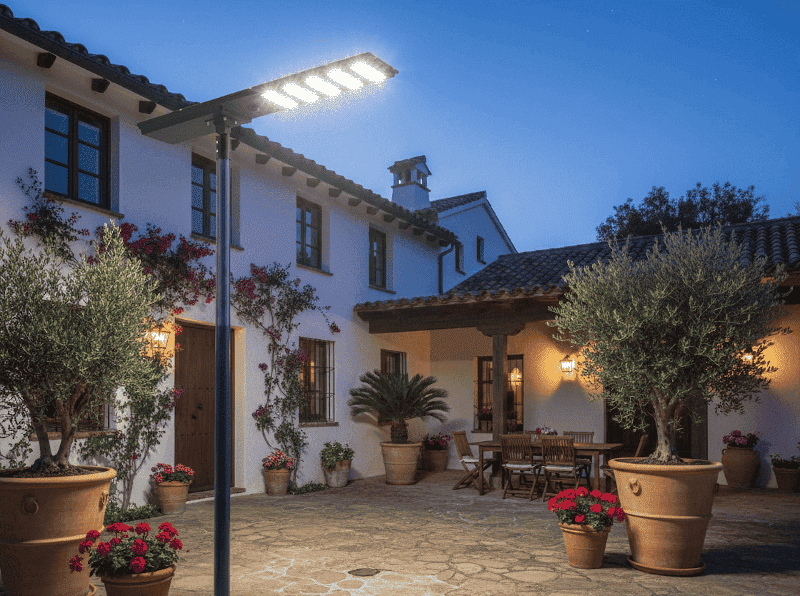
- Outdoor Residential Lights: Perfect for illuminating your porch, garden, or driveway. These are weather-sealed and stay outside 24/7.
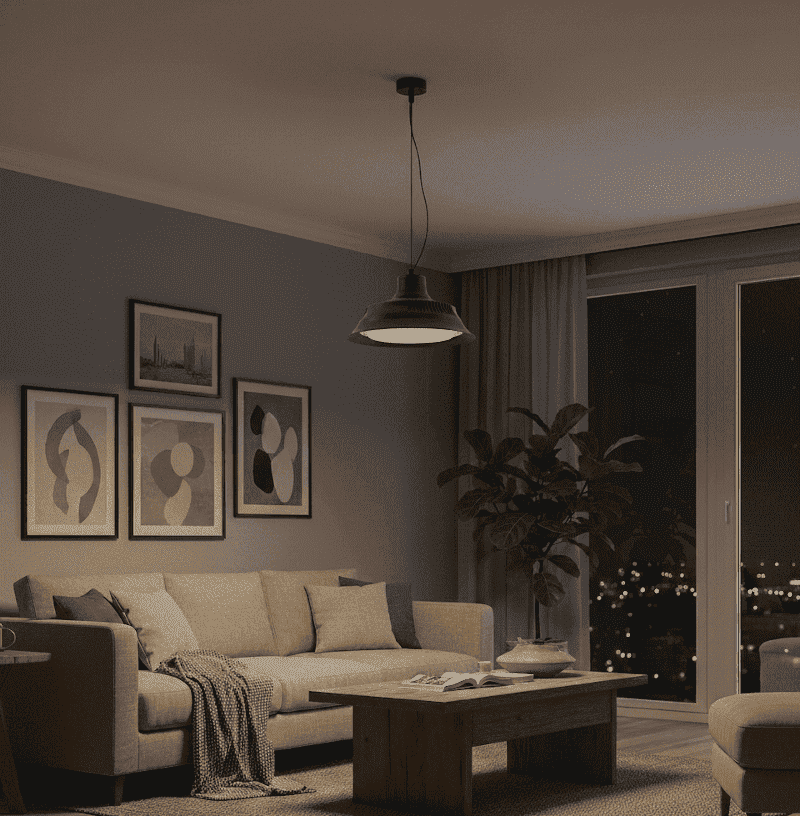
- Indoor Solar Lamps: These are game-changers for apartments or houses. The solar panel is mounted outside (on a roof or balcony), while the lamp is wired into your living room or kitchen.
The Rule of Thumb: If you need to light your yard, go with an Outdoor model. If you need to light your dinner table or bedroom during a blackout, choose an Indoor model with a detachable panel.
The Buyer’s Guide: Key Parameters That Actually Matter
Don’t be fooled by flashy packaging. To get a lamp that actually works, you need to look at these four technical pillars:
1. Power and Brightness
Higher wattage means more light, but it also means faster battery drain.
- Pro-Tip: Don’t just go for the highest wattage. For security and longevity, choose a lamp with a Motion Detector (PIR sensor). It provides 100% brightness when you’re there and drops to an “economy mode” when you aren’t, saving the battery for when it’s truly needed.
2. Light Temperature (Kelvin)
The “feel” of your light depends on the temperature. High Kelvin looks like a hospital; low Kelvin looks like a cozy home.
| Light Temperature | Appearance | Best For… |
| 2700K – 3000K | Warm Yellow | Living rooms, bedrooms, cozy patios. |
| 4000K – 4500K | Natural White | Kitchens, workspaces, garden paths. |
| 5000K – 6500K | Cool Blue/White | Security lighting, driveways (high visibility). |
3. The Battery: The Heart of the System
The battery determines how long the light stays on at night. Capacity is measured in Amp-hours (Ah).
Comparison: How long will a 100W LED Lamp run on different batteries?
(Assuming 100% constant output)
| Battery Capacity | Estimated Runtime | Recommendation |
| 6 Ah | ~1–2 Hours | Only for motion-sensor use. |
| 12 Ah | ~3–4 Hours | Basic evening lighting. |
| 20 Ah | ~6–8 Hours | Reliable all-night lighting. |
| 30 Ah | ~10+ Hours | Heavy-duty/Professional use. |
Battery Types: Why Chemistry Matters
We recommend LiFePO4 because it handles thousands of charge cycles without losing capacity, unlike standard Lead-Acid or basic Lithium-ion.
4. The Solar Panel: Your Power Plant
The panel must be strong enough to refill the battery during the day. In sunnier regions (like California or Spain), a smaller panel works. In cloudier regions (like Northern Europe), you need a much larger surface area.
Panel Selection Guide (To charge battery in ~12 daylight hours):
| Battery Size | Required Panel Power (Watts) |
| 6 Ah | 10W – 15W |
| 12 Ah | 25W – 30W |
| 20 Ah | 45W – 50W |
| 30 Ah | 60W – 80W |
We provide premium solar lights with perfectly matched components. You don’t have to worry about calculating battery sizes or panel power yourself—we’ve already taken care of everything. Head over to our store and pick the solar lamp that’s just right for you!
Conclusion: Real Savings in Action
Choosing the right solar lamp is a balance of science and lifestyle. It’s about understanding your local geography and your specific lighting needs to achieve something priceless: independence from the grid.
To see how this works in the real world, let’s look at the Smith family from New York. Tired of rising electricity rates, they decided to replace their old 200W grid-powered outdoor floodlight with a high-performance RA-YG-CK-A Solar LED Street Light (200W).
The Math of Independence:
- Initial Investment: They purchased the unit for $220. Since it’s a “plug-and-play” system, they installed it themselves in 15 minutes, saving hundreds on electrical contractor fees.
- Electricity Savings: In New York, the average electricity rate is approximately $0.23 per kWh. Running a 200W light for 12 hours a night consumes 2.4 kWh per day.
- Monthly Savings: $0.23 × 2.4 kWh × 30 days = $16.56 per month.
- Yearly Savings: $16.56 × 12 months = $198.72 per year.
The Result: The Smith family will “break even” in just 13 months. After the first year, their outdoor lighting is completely free for the next decade or more.
Stop worrying about the next utility bill and start harvesting the energy that hits your roof every single day. By choosing a system with perfectly matched components, you aren’t just buying a lamp—you are investing in a future where you control your costs.
Need help calculating the exact setup for your home? Stay tuned for our next article where we dive deep into solar panel placement and angle optimization!