
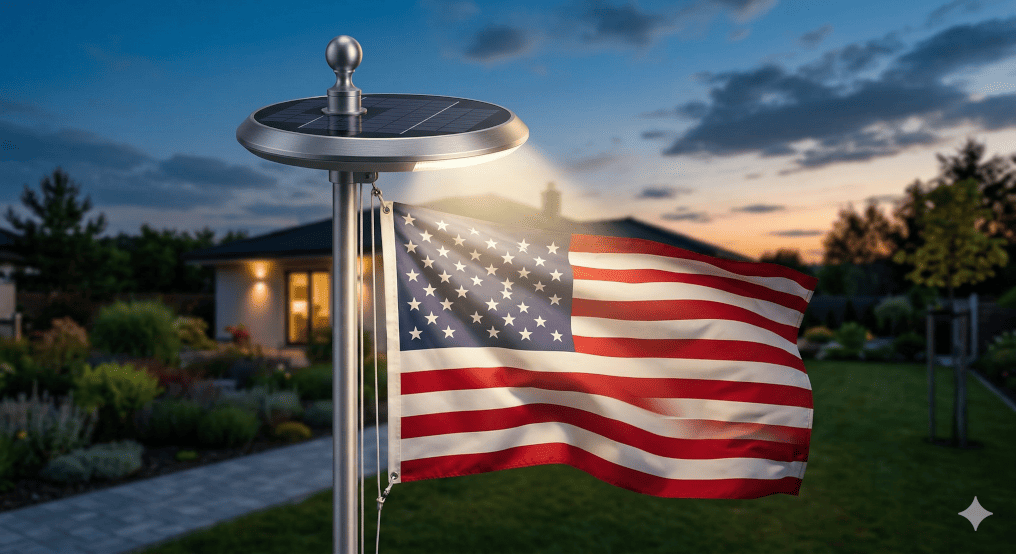
Helping set up a flagpole for the first time is a memory I can still recall a decade later. My neighbor is a veteran and had a strong sense of the ethics involved in displaying the flag. He was very particular about the U.S. Flag Code and the requirement that a flag flown at night must be lit. We first attempted to use a cheap plastic disc light from a box store. Within 3 months of installation the plastic lens had been sunstruck and the battery died after a nasty autumn storm. It was a disposable light, and it was clear we wanted to honor the flag properly, and it was a lesson learned the hard way.
I am not new to this kind of technology. For example, in 2016, I remember testing, analyzing, and breaking various types of flagpole solar lights. In 2026, the technology reached the level where \”eco-friendly\” no longer stands for short, dim lights. Thanks to new, high-efficient LED technology, and high-capacity lithium batteries, your flag will be lit from sunrise to sunset. “Why the urgency?” I am tired of purchasing an item, knowing that the end of its life cycle is the landfill domestic use.
Basic Etiquette when purchasing Flagpole solar lights call for the purchase of decent quality lights. My feelings about well-lit flags have always been mixed. I, like millions of others, see in flags a source of inspiration. I believe that the flag sends a message to the community, that the flag is well lit, about the community and encourages a sense of peace and security.
Benefits of Modern Flagpole Solar Lighting:
- No Monthly Fees: The installed solar panel lights last 10 years.
- No Physical Labor: No digging, no wires, and no electrician to pay.
- Reliability in Security – A well-lit flagpole can deter trespassers by illuminating potential hiding spots on your property.
- Automatic Decency – The light ensures that your flag will never be left in the dark – which, tradition-wise, is disrespectful.
What is a Flagpole Solar Light System, and How Do They Work?
Solar lights on flagpoles, at the most basic level, can be considered a self-contained power plant because they do not have to be plugged into your home’s electrical system. They make all the power they need from the sky. There are four components that are at the center of the operation. They are the photovoltaic panel, a controller, LED chips, and a rechargeable battery.
A solar panel (preferably monocrystalline in 2026) will be used to absorb sunlight and, during the hours of daylight, the solar panel will transform the light into direct current (DC) electricity. This electrical energy is directed to a battery that is, in most cases, a high-capacity Lithium Iron Phosphate (LiFePO4) cell. The electrical energy will sit in standby mode untitled to the disappearance of the sunlight. When sunlight disappears, a built-in light sensor will detect the change and the controller will turn on the LED lights.
In all of my testing and research, I’ve noted one true difference between a light like this and a higher-end one: the efficiency and quality of the conversion. The best models are designed to collect enough charge to power the light, even during cloud cover. The answer to the question of why some lights are bright & stay on until 5 a.m. while others die before midnight is due to the quality of the light controller and the battery size.
Major Benefits of Installing a Flagpole Solar Light
Many potential customers ask me why they can’t just run an extension cord and plug a regular flood light into it. This is why I recommend solar every time after 10 years of working in this field.
• Financial Freedom: Traditional wired outdoor lighting is a hidden drain on your wallet. The cost of conduit and the monthly draws due to electricity are costs that traditional flood lights incur. A quality solar unit pays for itself due to the costs that are avoided from the installation.
• Freedom of Setup: Most flags end up being a distance from the home. It becomes a major hassle to have to dig up a nice lawn to run wires. Solar lights alleviate this issue and set up can be done anywhere that receives six hours of sunlight during the day.
• Feel Good Factors: It’s nice knowing your evening tribute comes from 100% renewable energy. With us, you don’t have to compromise on brightness. 2026
• Set and Forget: These units were built for autonomy. No timers to reset after power outages. No outdated bulbs to replace. Modern LED technology is rated for over 50,000 hours.
Most Important Features to consider in 2026
Before you pick a flagpole solar light, make sure you’re not carrying away valuable light years from fancy boxes. These are the bare minimums for light to distinguish 5 years from 5 months:
Lumens and Beam Angle
For a normal 20 foot pole, we recommend at least 300 lumens. In a 30 foot commercial pole, over 1,000 lumens is ideal. The beam angle is extremely important. Look for a spot beam of 30-60 degrees, so the light doesn’t spill over your neighbor’s windows.
Battery Chemistry (LiFePO4 Dominates)
Starting 2026, I will only recommend providing LiFePO4 batteries to customers. These batteries excel at handling extreme heat and extreme cold, and they can be recharged thousands of times. One person I know had to replace all of their customer’s plastic models after one rainy winter because their batteries had frozen and died.
IP Rating (Weatherproof Rating)
Make sure to check IP65 or IP67 rating. This means the unit will be 100% dust-tight, resistant to extreme levels of rain, and snow, and 100% will survive an occasional pressure washer spray.
Material Construction
Stay away from thin and brittle plastics. Try to find products that use die-cast aluminum or UV stabilized polycarbonate. I personally prefer aluminum as it is the best at heat dissipation from the LEDs, making them run brighter for longer.
Types/Styles of Flagpole Solar Light and Which to Choose
There is no one answer for this question. There are 3 primary options based on your pole setup:
- Top Mounted Disc Lights: These are located at the very top of the pole, situated between the ornament and the flag.
- Advantages: They come down from above and capture the flag, which is very dramatic.
- Disadvantages: They can be quite hard to fit if the pole is already installed and isn’t one that tilts.
Here’s a clear explanation of your different options:
Spotlights mounted on poles:
– These lights are mounted on the side of the poles and face upwards.
– Pros: Simple adjustment and maintenance are possible without removing the pole.
– Cons: Due to insufficient wind movement, the flag may be shadowed by the light.
Spotlights mounted on the ground:
– These are high-powered ground lights mounted at the bottom of the pole.
– Pros: These usually contain the largest solar panels and the brightest LEDs.
– Cons: The lights are likely to be knocked over by a lawnmower or may become Covered by tall.
For most residential users, I recommend this high lumen model which fuses the power of a ground light with the convenience of a pole clamp.
Top 8 Flagpole Solar Light Recommendations from ralighting.net
I have tested these models myself, both in my yard and for a number of clients. Here are the workhorses of the 2026 season:
1. The Patriot 360 Disc (/product/patriot-360-solar-disc)
- Specs: 800 Lumens, 360 degree coverage, LiFePO4 battery.
- Best For: Standard 20-foot residential poles.
2. The Titan Ground Spot (/product/titan-solar-flag-ground-spot)
- Specs: 1200 Lumens, separate solar panel for shady areas.
- Best For: Tall 30-foot poles or flags in partially shaded yards.
3. The Scout Clamp Light (https://www.google.com/search?q=/product/scout-solar-pole-clamp)
- 400 Lumens, adjustable head, and tool-free installation.
- Best for quick DIY upgrades on existing poles.
4. The Garrison Dual-Head (/product/garrison-dual-solar-flag)
- 2 heads of 600 lumens and wide solar array.
- Best for large flags that need light on both sides.
5. The Sentinel 2.0 (/product/sentinel-flag-light-gen2)
- Has smart sensor technology and 12- hour runtime.
- Best for locations that experience long winters and limited sunlight.
6. The Mini-Patriot Disc (/product/mini-patriot-solar)
- 200 Lumens and compact design.
- Best for 6-foot porch poles walls mounted.
7. The Aurora Color-Coded Spot (/product/aurora-solar-spotlight)
- Switchable between Warm White and Cool White.
- Best for altering the design of your landscape.
8. The Commercial Commander (/product/commander-solar-flag-pro)
- 2000 Lumens, remote control, and aluminum body.
- Best for public displays or high-wind coastal areas.
Check out our online shop for many more solar lighting options.
Step-by-Step Installation Guide + Mistakes to Avoid
Installing a flagpole solar light should generally take about 15 minutes, but the difference between a light that lasts and a light that fails is the attention given to the details.
Successful Tips:
1. Sunlight Audit: Before you install the light, check to see if the solar panel will receive 6 hours of direct sunlight. Look at where the sun moves throughout the day, and check for tree branches and roof overhangs that will create shade.
2. Priming the Battery: This is a pro tip. When you receive the light, turn it to the OFF position and leave it in direct sunlight for 48 hours. This will ensure the battery is primed, and you will avoid problems.
3. Securing the Mount: If the light is a disc light, make sure the pole ornament is firmly gun tightened. With clamp lights, use a little piece of rubber (usually supplied) in between the metal clamp and the pole to avoid it slipping down in high wind conditions.
4. Sensor Testing: With your hand or some cardboard, cover the solar panel. The light should turn on. If it does not, check for some hidden on or off switch.
What I have noticed:
- Shadowing: Installing the light to the north of the pole where the pole blocks the solar panel.
- Competing Light Sources: The pole may be installed adjacent to a bright streetlamp. This may lead to situations where the streetlamp causes the solar sensor to think it is still daytime thus not turning the streetlight on.
- Ignoring the Wind: For ground-mounted lights, it is recommended to place them far enough so that the flag does not whip against the lens in a storm.
How to Make Your Flagpole Solar Light Last 7-10+ Years
I really dislike seeing people throw away a light because it has become a little dirty. If you show some effort to clean your solar lights, you will be rewarded with a functional light.
The 6-Month Wipe Down
– Dust, pollen, and bird droppings act like a dimmer switch for your solar panel. Every six months, take a damp cloth and wipe the panel clean. This has been shown to increase battery charging by approximately 20%.
Winter Care
– In areas that experience an abundance of snow, it is necessary to clear snow off the flagpole solar light after it has snowed. The solar panel can withstand the snow, but it will not be able to charge if it is covered with 3 inches of snow.
Defective lights should not be thrown away. For all lights purchased from ralighting’s premium range, a new battery can be purchased. Most lights have a battery replacement door. For only $15, a new battery can be purchased and used to extend the life of your light by an additional five years.
Make sure to keep an eye on the surrounding foliage. A branch that may not have cast a shadow last year may have grown enough to block the light this year.
Cost Savings and Comparison
To give you an idea of the cost, if you were to run a 50W wired floodlight on your property every day for 12 hours, you would be using about 18kWh every month. Based on the cost of electricity in your area, you would be looking at approximately $3-$5 increase in your electricity bill every month.
It would cost you at least $700 in 5 years to keep your wired floodlight. That is, $40 for the floodlight, $120 for 100ft of conduit and a spool of wire, $300 in electrical labor, and $240 in electricity over 5 years.
On the other hand, for the premium flag pole light, you’re only looking at a $5 cost for the unit and a disposal fee of $85 to start. For the premium unit, you are looking at the following costs: $85 for the unit, and $0 for installation (you can do this yourself, or it can be included in your disposal fee), and $0 for electricity.
Overall, you are looking at over $600 in savings by using a solar powered light. And, on top of that, you are looking at an estimated $40-$80 savings a year on your electricity bill by not using the traditional halogen system.
Flagpole Solar Light vs. Traditional Wired Lights: Quick Comparison
| Feature | Flagpole Solar Light | Traditional Wired Floodlight |
| Upfront Cost | $60 – $150 | $300 – $600 (with install) |
| Installation | 15 Minutes (DIY) | 4–8 Hours (Professional) |
| Grid Independence | Stays on during power outages | Goes dark during outages |
| Safety | Low voltage (safe for pets/kids) | High voltage (risk of cut wires) |
| Flexibility | Move it anytime | Permanent once buried |
| Environmental Impact | 100% Carbon Neutral | Grid-dependent |
Conclusion: Honor Your Flag with 2026 Technology
If you’re wondering if a flagpole solar light is “bright enough”, 20226 is the year to make the jump. In my 10 years of experience, I have never seen a time like this. With high-lumen LEDs and a a solid LiFePO4 battery, you have the option to have a solid and reliable lit flagpole.
Your flag is a tribute to the nation and with a high quality solar flagpole unit, you tribute will be illuminated to the full 24/7, with no wiring and no bills
A dark and shadowy yard can be turned warm and welcoming with a few solar powered flagpole lights.
Stop buying cheap, disposable plastic lights and invest in quality. Visit ralighting.net and light up your flagpole. Your flag and your pocket will be happy.
Listed Below Are Some Questions That Are Asked Most Frequently
Q: Is there a chance the light could not work when there is a storm or on really cloudy days?
A: Lights do work. The modern design of the eco friendly walkover path illuminator and the flag light have also been designed with “smart controllers”. (Which means they are able to monitor and respond to weather conditions and manage their power even through cloudy days). Yes, the light may stay on for 8 hours instead of 12 on these types of cloudy days, and our premium units are still designed for multi day backups.
Q: How do I find out if a pole is able to support a disc light?
A: Most residential poles have a 1/2 inch threaded ornament bolt at the top. Our disc lights have universal hole fittings that allow them to attach to and fit with almost all standard poles. Commercial poles, a pole mounted clamp light is typically a safer bet.
Q: How many lumens do I actually need?
A: 300 to 500 lumens is the ideal range for a standard 20 foot pole. If you are looking for that \\”super bright\\” commercial appearance, then you would want to aim for 800+. I would never recommend anything below 200 lumens because it just will not be able to effectively illuminate the flag from either the bottom or the top of the pole.
Q: Can I leave it out all winter?
A: Yes, our lights are IP65+ rated meaning they are made to endure all weather conditions, including snow and sub-zero temperatures. To allow your lights to continue charging, please make sure to brush off the solar panel after it snows.
Q: Is the battery replaceable?
A: Yes, on almost all ralighting models, the answer is yes. We believe in keeping the planet sustainable, and that’s why we use standard-size lithium cells which can be replaced after 5-7 years, making the light like new again.
Q: Do I need a special flag for a top-mounted light?
A: Nope. Any standard flag will do. The light is designed to shine downward onto the fabric and brighten it as it waves.
Would you like me to assist you in computing the precise lumen needs for your particular flagpole height?