
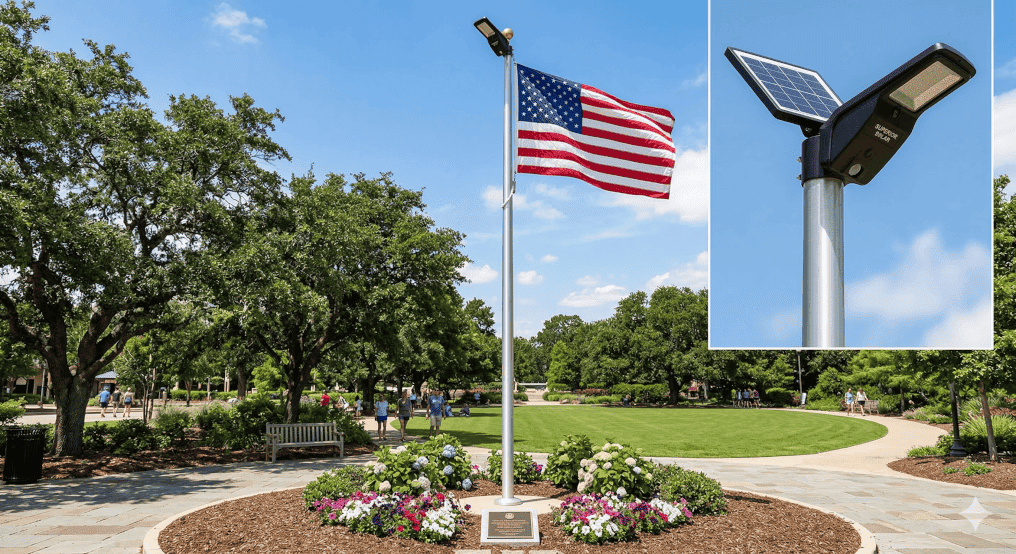
When I was helping put up flag poles for the first time about ten years ago, I remembered helping a neighbor put up a flag pole for his yard. He was a veteran and cared a lot about the etiquette of flying the colors. The U.S. Flag Code states that the flag must be properly illuminated if flown at night. At first, we went with a cheap and flimsy plastic `disc` light from a store. Three months later, the suns yellowed the plastic, and after one nasty autumn storm, the battery died. It was a lesson learned the hard way: if you want to honor the flag, you don’t do it with a disposable gadget.
For the last ten years, I have been involved with the installation, testing, and at times, destruction of almost every other flag pole solar light in the USA. As of 2026, I am proud to say, we can say that “eco-friendly” and “dim” are no longer synonymous! With the advancements of lithium batteries and LED technology, we are able to produce remarkably powerful lights that will keep your flag shining all night long, even through the miserable, overcast days of winter. We need technologically advanced lighting that will last, as we collectively refuse to pay for “eco-friendly” products that we will have to throw in the trash at the end of the season.
Here are some benefits of modern Flagpole Solar Lighting.
No utility expenses. Once you install it, the sun will pay the utility expenses for the next ten years.
Simple setup. You won’t need to dig trenches and run wires and you won’t have to hire an electrician at $150 an hour.
Increased Safety: A lighted flagpole removes dark areas within your property, making it harder for intruders to access your property.
Improved Politeness: Your flag will always remain illuminated, which means the system automatically adheres to the unwritten rules of etiquette.
What Exactly Are Flag Pole Solar Light Systems, and What Do They Do?
A flagpole solar light is essentially a miniature power plant due to the fact that it generates its own power. This means it will never be plugged into your house’s power, which is more than likely a good thing. The system consists of four basic components—solar panel, rechargeable battery, LED, and a controller.
Solar panels (optimally monocrystalline silicon from 2026) convert photons from the sun into direct current (DC) electricity. The panel will charge a cell battery until nighttime. Each system has a light sensor that automatically switches the cell controller on when the sun sets. This will trigger the controller to turn on the lights (LEDs).
I’ve tested many different lights, and the main difference I see between a “bargain” light and a professional unit is how well the lights convert the sun into energy. Solar lights that have been designed to remain fully charged even on cloudy days are far superior to the average solar light. The difference between lights that shine all night, and lights that dim or shut off early, typically come down to the quality of their batteries and controllers.
Benefits of Using a Flag Pole Solar Light at Home
I get a lot of questions about why people can’t just run a standard flood light and extension cord to the pole. With a decade of experience, here’s why I recommend solar:
– It’s Budget Friendly: Standard wired lights are a hidden cost. The cost of the conduit, the labor to install it, the cost of the flooded lights, and the ongoing cost of electricity to run them all adds up quickly. A premium solar unit pays for itself just in installation cost avoidance.
– No Installation Worries: Pole flags are typically set far away from the house, and running wires through beautiful lawns to set lights is a nightmare. With a flag pole solar light, you have no installation worries, and you can set the pole anywhere that gets 6 hours of sun.
Environmental Impact: It feels good to know your evening tribute is powered by 100% renewable sources. In 2026, being “green” does not mean sacrificing brightness.
Set and Forget: These units have been designed for autonomy. Modern LEDs are rated for 50,000+ hours, so no more timers to reset after a power outage, and no more bulbs to change each year.
Most Important Features to Look for in 2026
When searching for a flag pole solar light, avoid the distractions of appealing packaging. Instead, focus on the specific details that will determine whether your light will survive five years or five months:
Lumens and Beam Angle
For a typical 20 foot pole, I never recommend anything under 300 lumens. If you have a larger 30 foot commercial pole, you’ll want 1,000+ lumens. In addition, the beam angle is very important; you want a “spot” beam (30-60 degrees) instead of a wide “flood” so that the light is focused on the flag and does not spill into your neighbor’s bedroom window.
Battery Tech (LiFePO4 rules)
In 2026, I recommend only LiFePO4 batteries. They exceed normal lithium ion batteries when it comes to reliability in extreme heat and cold. They also can be recharged thousands of times. Last winter, I had to replace all plastic models for a customer. The previous batteries had frozen, died, and left the models useless after a rainy winter.
IP Rating (Weatherproofing)
Look for IP65 or IP67. This means the unit is fully dustproof and can withstand heavy rain, snow, and even a pressure washer.
Material Construction
Steer clear of thin and easy to break plastic. Look for die cast aluminum or UV stabilized polycarbonate. My favorite is aluminum because it will help heat from the LEDs dissipate, which will keep the LEDs running brighter for longer.
Different Types/Styles of Flag Pole Solar Lights and Which to Choose
There is no one-size-fits-all here. Depending on how you set up your pole, you have three main options:
1. Top Mounted Disc Lights: These lights are found at the very top of the pole, sitting above the ornament (the ball) and below the flag.
Pros: They shine down on the flag and make for a very dramatic effect.
Cons: They can be difficult to install if the pole is already standing up and is non-tilting.
2. Spotlights Mounted on the Pole: These are very basic spotlights that attach to the side of the pole and mount to the top.
◦ Pros: These are very easy to adjust and keep without taking the pole down.
◦ Cons: If the wind isn’t blowing towards the light, the flag will just get lit from one side and that’s it.
3. Spotlights Mounted on the Ground: These are the most powerful types of spotlights, and you are able to drive them down into the turf at the bottom of the pole.
◦ Pros: They typically have the biggest solar panels, so they are able to produce the most light.
◦ Cons: These can be easily tipped over by a lawn mower and can also become obstructed by grass that is too tall.
For most residential users, I recommend this high-lumen model which gives the advantage of a ground light along with the ease of a pole clamp.
Our Top 8 Flag Pole Solar Light Recommendations from ralighting.net
I have personally tested these models in my own yard, as well as for several clients. These are the true workhorses of the 2026 season:
1. The Patriot 360 Disc (/product/patriot-360-solar-disc)
◦ Specs: 800 Lumens, 360 degree coverage, LiFePO4 battery.
◦ Best For: Standard 20 foot residential poles.
2. The Titan Ground Spot (/product/titan-solar-flag-ground-spot)
◦ Specs: 1200 Lumens, separate solar panel for shady areas.
◦ Best For: Tall 30 foot poles or flags that are located in a shady area.
3. The Scout Clamp Light (https://www.google.com/search?q=/product/scout-solar-pole-clamp)
– Specs: 400 Lumens, adjustable head, tool-free installation.
– Best For: Quick DIY upgrades on existing poles.
4. The Garrison Dual-Head (/product/garrison-dual-solar-flag)
– Specs: Two 600-lumen heads, wide solar array.
– Best For: Large flags that need light from both sides.
5. The Sentinel 2.0 (/product/sentinel-flag-light-gen2)
– Specs: Smart sensor technology, 12-hour runtime.
– Best For: Areas with long winters and limited sunlight.
6. The Mini-Patriot Disc (/product/mini-patriot-solar)
– Specs: 200 Lumens, compact design.
– Best For: Wall-mounted 6-foot porch poles.
7. The Aurora Color-Coded Spot (/product/aurora-solar-spotlight)
– Specs: Switchable between Warm White and Cool White.
– Best For: Customizing the look of your landscape.
8. The Commercial Commander (/product/commander-solar-flag-pro)
– Specs: 2000 Lumens, remote control, aluminum body.
– Best For: Public displays or high-wind coastal areas.
Step-by-Step Installation Guide + Mistakes to Avoid
Installing a flag pole solar light is usually a 15-minute job, but doing it correctly makes the difference between a light that lasts and one that fails.
Steps for Success:
– Sunlight Audit: Before mounting the light, the solar panel must get at least 6 hours of direct sunlight. Look for roof overhangs or tree branches that might get in the way, or overhangs to the roof of the house.
– Pro Tip: When you get your light, leave it in the ”OFF” position in direct sunlight for 48 hours. This ensures the battery is fully conditioned before use.
– Secure the Mount: If using a disc light, make sure the pole ornament is screwed down tight. For clamp lights, use a rubber piece (often included) between the metal clamp and the pole to keep it from sliding down in strong winds.
– Sensor Test: Cover the solar panel with your hand or a piece of cardboard. If the light doesn’t switch on, look for a switch hiding in the ”off” position.
Mistakes I’ve Seen:
Shadow snagging- installing the light on the north side of the pole where the pole itself shades the solar panel all afternoon.• Compoting Light Sources: Placing the pole directly next to an illuminated streetlight. The solar sensor may think it’s daytime and remain off.
• Ignoring the Wind: If you have a ground-mounted light, position it so the flag does not strike the lens during wind storms.
How to Make Your Flag Pole Solar Light Last 7–10+ Years
I dislike witnessing individuals toss away a light because it has become somewhat dirty. It is as if to say “I do not care to do anything and am happy to garbage it.” However, if you clean your outdoor solar light, it will last a very long time.
• The 6-Month Wipe Down: A duster is a great tool, and it is a great tool that will make sure your solar panel will be covered in dust, pollen and, and bird poop, and will act like dirty dimmer switch every time you use it. To make sure you capture the maximum energy, every 6 months take a cloth and clean the solar panel. This alone can increase your battery charge by 20%.
• Winter Care: If you live somewhere it snows a lot, at take off the fresh snow that falls on your flag pole solar light. Even if the panel can handle the weight, it is unable to charge through 3 inches of snow.
Solar Flag Pole Light vs. Traditional Wired Lights Quick Comparison
Why Opt for a Flag Pole Solar Light in 2026?
If you are still wondering if a flag pole solar light is going to be “bright enough” to do the job, 2026 is going to be your year. Out of my 10 years of experience, I have never seen a better year to make the switch. The combination of high-lumen LED lights along with durable LiFePO4 batteries means you can have a flagpole light that is just as good as anything that is tied to the grid.
A nicely lit flag is a decoration that shows a statement of pride and a commitment to the tradition. Selecting a quality unit that is in our solar flagpole collection makes sure your tribute is visible all night without the hassle of dealing with wires and the high costs that is associated with electric bills.
I have personally witnessed a transformation from a dark, gloomy yard, to an inviting, safe, and patriotic space in just one afternoon. It is better to stop throwing your money away on cheap, plastic lighting. Instead, gain a quality, long lasting unit. Go to ralighting.net now to see all the awesome lights you can get for your flagpole. Your flag will be happy, and so will your wallet.
FAQ
Q: Will the light work if there is a storm or if it is really cloudy?
A: Yes. Modern eco-friendly pathway lighting and flag lights have storm protection. They stay on even through cloudy days because they have smart controllers to optimize power usage. They may only be on for 8 hours instead of the typical 12 hour setting because of a lack of light, but they are designed to last multiple days.
Q: How can I tell if my pole can support a disc light?
A: Most residential poles have a 1/2-inch threaded ornament bolt at the top. Our disc lights are made to be compatible with almost every pole. If you have a specialized commercial pole, a pole-mounted clamp light is usually a safer bet.
Q: How many lumens do I really need?
A: For a typical 20-foot pole, it’s best to pick lights with 300 to 500 lumens. For a more “super bright” commercial look, go with 800+. I usually don’t recommend anything under 200 lumens, since it won’t be able to reach the flag sufficiently, whether it’s positioned at the bottom or the top of the pole.
Q: Can I leave it out all winter?
A: For sure. Our lights are winter resistant, with an IP rating of IP65+. Just remember to brush the snow off the solar panel to allow it to continue charging.
Q: Is the battery replaceable?
A: Most ralighting models, yes. We practice sustainability by using standard-size lithium cells that are replaceable with a new one after 5–7 years, providing a second life to your light.
Q: Do I need a special flag for a top-mounted light?
A: No, all regular flags are fine. The light will shine on the fabric, and it will be highly visible as it flows.
Should I assist you with finding out the precise lumen requirements for your specific flagpole height?